

How Long Does It Take for a Business Blog to Work?
Business blogging usually does not produce meaningful results overnight. A new article may be published in an afternoon, but discovery, search visibility, reader trust, and customer inquiries develop on different timelines.
So, how long does business blogging take to work? There is no universal deadline. A useful article can begin helping your sales team or answering customer questions immediately. Search impressions may appear within days or weeks. A dependable stream of organic traffic and inquiries often takes months of focused, consistent work—and it is never guaranteed.
That answer may sound less exciting than a promise of instant traffic, but it is far more useful for planning. A business blog works best when you know what progress to watch for, what can slow it down, and when to adjust your approach.
First, decide what “working” means
A blog can support a business in several ways. Search traffic is only one of them.
Your blog may be working if it helps you:
- answer recurring customer questions;
- explain a service before a sales call;
- give prospects a reason to trust your expertise;
- attract impressions and clicks from search;
- support email or social media campaigns;
- create useful internal links across your website;
- generate better-informed inquiries; or
- shorten the time needed to explain common decisions.
These outcomes do not arrive at the same time. An article explaining your process can become a useful sales resource as soon as it is published. That same article may take much longer to earn consistent search traffic.
Before judging the blog, choose the outcomes that matter to your business. Otherwise, it is easy to dismiss useful progress simply because one traffic chart has not moved yet.
A realistic business blogging timeline
The stages below are not promises or deadlines. They are a practical way to understand what may happen as a useful content library grows.
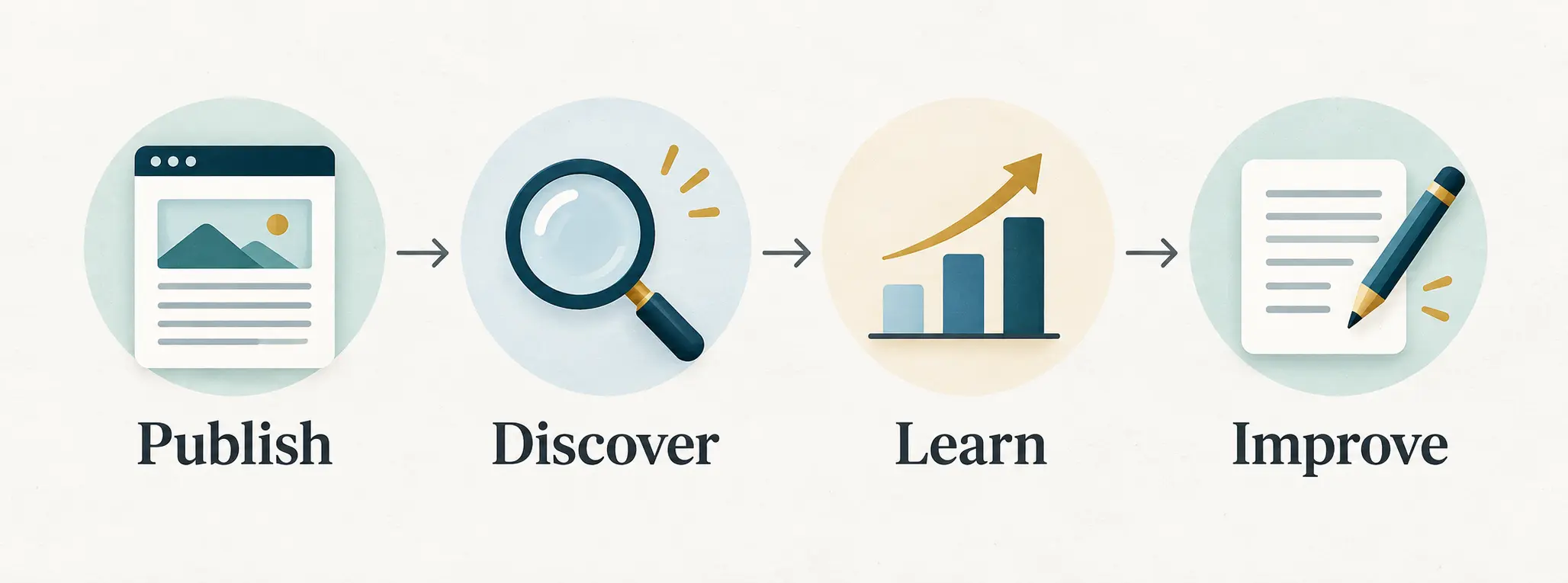
The first days and weeks: publish, connect, and confirm access
Early work is mostly foundational. Your article needs to be published correctly, linked from the site, available to search engines, and easy for readers to use on desktop and mobile devices.
Google explains that Search generally works through three stages: crawling, indexing, and serving results. It also makes clear that following technical requirements does not guarantee that a page will be crawled, indexed, or shown in search results. That is why the first milestone is not “rank number one.” It is confirming that the content is accessible, useful, and connected to the rest of the website.
During this stage, you can also use the article directly. Send it to a prospect who asks the question it answers. Share it through an appropriate social channel. Link to it from a related service page or existing post.
Those uses can create value before organic traffic develops.
The first one to three months: look for early signals
As you publish related articles, search engines and readers have more context for understanding what your website covers.
Early signals may include:
- pages appearing as indexed;
- the first search impressions;
- a small number of clicks;
- visitors reaching more than one page;
- prospects mentioning an article; or
- recurring questions becoming easier to answer.
Low numbers during this period do not automatically mean the blog has failed. A new or lightly established site may have little history, few backlinks, and a small content library. Search demand may also be limited or highly competitive.
Use this period to learn. Which topics earn impressions? Which articles keep readers engaged? Which questions lead naturally to a service page or inquiry?
If you need topic ideas, start with the questions customers already ask. Our list of 21 useful small business blog post ideas can help you turn those questions into a manageable plan.
Three to six months: patterns become easier to see
With several useful articles published, you may have enough information to identify patterns.
Some pages may begin earning impressions for unexpected search phrases. One topic may attract more engaged visitors than another. An older article may improve after you add an internal link from a newer, related post.
This is a better time for informed adjustments than the first week after publication. You can strengthen promising articles, clarify titles that do not match search intent, add missing examples, and connect related posts.
Google notes that improvements can sometimes affect search results within a few days, but broader changes may take several months to be recognized. That variability is one reason to evaluate a body of work over time rather than declaring success or failure after one post.
Six to twelve months and beyond: judge the system, not one article
After six to twelve months, a consistently maintained blog should give you a clearer picture of what the system is producing.
That does not mean every post will attract traffic or that the blog will automatically generate customers. It means you should have enough published work and performance data to ask better questions:
- Which topic groups attract the most relevant visitors?
- Which posts assist sales conversations or inquiries?
- Are impressions and clicks trending upward over a meaningful period?
- Are older posts still accurate and useful?
- Is the publishing pace sustainable?
- Which weak posts should be improved, combined, redirected, or retired?
A blog becomes more valuable when each article contributes to a connected library. One post answers a question, another compares options, and another explains what happens next. Together, they help readers move from uncertainty toward a decision.
Why business blogging timelines vary
Two businesses can publish similar articles and see very different results. Several factors affect the timeline.
Website history and authority
An established website with useful pages, relevant links, and existing search visibility may get new content discovered faster than a brand-new site. A new site often needs time to build a clear subject focus and a trustworthy body of work.
Topic competition and search demand
A narrow customer question may face less competition than a broad phrase pursued by national brands. However, a low-competition topic may also have limited search volume. The goal is not simply to chase the largest number. It is to answer questions that attract the right readers for your business.
Content usefulness and search intent
An article can be well written and still miss the reader’s real need. A person searching for a price comparison will not be satisfied by a vague company history. A reader who needs a checklist may not want a long opinion piece.
Google’s people-first content guidance recommends creating helpful, reliable information for people rather than publishing primarily to manipulate rankings. Clear intent, genuine usefulness, and appropriate firsthand expertise matter more than filling a calendar with generic posts.
Technical access and internal linking
Useful content cannot perform well if search engines cannot access it or readers cannot find it. Indexing settings, crawlable links, mobile usability, site speed, and a working sitemap all contribute to a healthy foundation.
Internal links also help readers and search engines understand relationships between pages. A new article should not sit alone without a path from other relevant content.
Publishing consistency
Consistency gives you more chances to answer useful questions and learn from actual results. It does not mean publishing as often as possible.
For many small businesses, one or two strong articles per month can be more realistic than an aggressive weekly schedule. Our guide to how often a small business should publish blog posts explains how to choose a pace the business can maintain.
What should you measure?
Traffic is important, but one number cannot explain the entire value of a business blog.
Search impressions
An impression means a link to your site appeared in a Google search result under the conditions Google uses for that result type. Impressions can show that a page is beginning to gain visibility even before it earns many clicks.
Search clicks and click-through rate
Clicks show that searchers visited your site from a result. Click-through rate compares clicks with impressions. A page with impressions but few clicks may need a clearer title, a more relevant description, or a better match for the searcher’s intent.
Google Search Console’s Performance report can show clicks, impressions, click-through rate, average position, queries, and pages. Review trends over a useful period instead of reacting to every daily change.
Reader engagement
Look at whether visitors stay long enough to use the article, continue to another relevant page, or complete a meaningful action. Engagement is not proof of a sale, but it helps distinguish useful visits from accidental ones.
Sales and service value
Record when an article supports a proposal, answers a question before a call, helps train a team member, or gives a customer confidence to take the next step.
These outcomes may not appear in a search dashboard, but they are still business value.
Inquiries and conversions
Track contact-form submissions, calls, appointments, downloads, or other actions that matter to your business. When possible, ask new customers how they found you and which information helped them decide.
What if the blog is not showing progress?
If you have published consistently for several months and see little meaningful activity, do not simply produce more of the same content.
Review the system in order:
- Confirm technical access. Make sure important pages can be crawled and indexed and that your sitemap and internal links are working.
- Recheck the topic. Is it based on a real customer question or only on a broad keyword?
- Match the search intent. Does the article give the reader the format and answer they expected?
- Improve the page. Add clarity, examples, firsthand knowledge, useful visuals, or a stronger next step.
- Strengthen related content. Build a small group of connected articles rather than publishing unrelated topics.
- Promote it appropriately. Share the article where existing customers and prospects are likely to see it.
- Measure the right outcome. A sales-support article may be valuable even if it never becomes your largest traffic source.
The answer is rarely “publish anything more often.” A better answer is usually to publish more deliberately.
Can you make a business blog work faster?
You cannot force search engines to rank a page or guarantee a traffic deadline. You can remove avoidable delays and improve the quality of the work.
Start with a focused plan:
- choose topics tied to real customer questions;
- group related articles around subjects your business understands;
- publish on a schedule you can maintain;
- review facts, links, formatting, and mobile presentation;
- connect new posts to useful existing pages;
- share each article through relevant channels; and
- revisit published content when new information or performance data justifies an update.
This process is less dramatic than chasing a shortcut, but it produces a more useful website and better information for future decisions.
Consistent execution matters more than a perfect forecast
No responsible provider can promise that a business blog will reach a specific ranking, traffic number, or inquiry count by a fixed date. The timeline depends on the website, market, topics, competition, content quality, technical foundation, and how well the articles serve real readers.
What you can control is the system: choosing useful topics, researching them carefully, publishing consistently, checking the results, and improving the library over time.
If that process keeps slipping behind daily business demands, a managed service can provide the structure needed to keep it moving. See what a blog management service includes for a clear look at the workflow, or contact Managed Authority Blog to discuss a realistic plan for your business.