

What Should a Small Business Blog About? 21 Useful Post Ideas
Starting a business blog often sounds simple until you face an empty page and ask the obvious question: What should we write about?
The best small business blog post ideas usually do not come from trying to sound clever or chasing every popular topic. They come from the questions customers already ask, the decisions they struggle with, and the problems your business helps them solve.
That is good news. You do not need an endless supply of groundbreaking ideas. You need a practical way to turn what your business already knows into useful articles for the people you want to reach.
The 21 ideas below can work for service businesses, consultants, local companies, online businesses, and many other small organizations. Use them as starting points, then adapt each one to your customers, your expertise, and the way you actually do business.
Begin with the questions your customers already ask
Before opening a keyword tool or looking at a competitor’s blog, make a list of the questions you hear during phone calls, estimates, appointments, sales conversations, and support requests.
Pay attention to questions such as:
- How much does this usually cost?
- How long does it take?
- What should I do before we begin?
- Which option is right for my situation?
- What commonly goes wrong?
- Can I handle this myself?
- How do I know whom to trust?
Each question can become a useful article. Better still, the article will address a concern that matters to a real buyer rather than filling space on a publishing calendar.
Google’s guidance encourages website owners to create helpful, reliable content for people instead of content designed mainly to manipulate search rankings. That makes customer questions an excellent starting point: they keep the article grounded in a genuine need.
21 small business blog post ideas you can adapt
You do not need to use all 21 ideas at once. Choose the few that best match your customers’ current needs and your business goals.
1. Answer one frequently asked question
Take a question you hear repeatedly and give it a clear, complete answer. A roofing company might explain how long a typical roof replacement takes. A bookkeeper might explain which records a new client should gather.
Keep the article focused on one question. A direct answer is often more useful than a broad overview that tries to cover everything.
2. Explain how your process works
Walk readers through what happens from the first inquiry to the completed service. Explain the major steps, who handles them, and what the customer can expect.
This type of article reduces uncertainty. It can also help potential customers feel more comfortable contacting you because they know what comes next.
3. Create a beginner’s guide
Introduce an important topic in plain language for someone encountering it for the first time. Define unfamiliar terms, explain the basic choices, and identify a sensible first step.
The goal is not to show how much you know. It is to help the reader understand enough to move forward confidently.
4. Share a practical checklist
Checklists make complicated tasks easier to approach. Consider a seasonal maintenance checklist, an appointment-preparation checklist, a moving checklist, or a list of information clients should gather before requesting a quote.
A strong checklist can also become a downloadable resource later.
5. Explain a common mistake
Describe a mistake customers often make, why it happens, and what they can do instead. Keep the tone helpful rather than critical.
For example, a landscaping company could explain why cutting grass too short can create problems. A marketing consultant could discuss why promoting every offer to the same audience weakens results.
6. Correct a common misconception
Every industry has advice that sounds reasonable but is incomplete, outdated, or wrong. Choose one misconception and explain the facts in a calm, balanced way.
Avoid creating controversy merely to attract attention. The article should leave the reader better informed, not more alarmed.
7. Compare two common options
Help readers understand the differences between two services, materials, plans, or approaches. Explain where each option fits, what tradeoffs matter, and who may benefit most from each one.
An honest comparison builds trust because it recognizes that the most expensive option is not automatically the best choice for every customer.
8. Explain what affects the cost
Customers often search for prices before they are ready to request a quote. Even when you cannot provide one universal number, you can explain the factors that influence the final cost.
Describe what is normally included, what may create additional expense, and which details a customer should provide for a more accurate estimate.
9. Describe a realistic timeline
Explain how long a typical project, service, approval, recovery, or onboarding process takes. Include the major stages and the factors that may speed up or delay progress.
Realistic expectations can prevent frustration later.
10. Publish questions customers should ask before hiring
Give readers a thoughtful list of questions to ask any provider—not only your company. Explain what a useful answer sounds like and which vague responses deserve further clarification.
This approach helps readers evaluate their options while demonstrating that your business is comfortable with transparency.
11. Show what happens behind the scenes
Readers may see the finished product without understanding the work required to produce it. Show the planning, preparation, quality checks, tools, or coordination that happen before delivery.
Behind-the-scenes content can make an unfamiliar service feel more tangible.
12. Turn a customer result into a case study
With the customer’s permission, explain the starting problem, the chosen approach, the work completed, and the result. Include meaningful details without revealing private information.
Avoid promising that every customer will achieve the same outcome. A case study is most credible when it explains both the process and the circumstances.
13. Create a troubleshooting guide
Choose a specific problem and walk readers through the safest, most sensible checks. Explain what they can try themselves and when they should stop and call a professional.
This format is especially useful for home services, technology, equipment, and recurring operational problems.
14. Define important industry terms
Create a plain-English glossary for the words customers encounter when comparing options or reviewing a proposal. You can explain several related terms in one article or build a short series over time.
Clear definitions help readers make better decisions and reduce misunderstandings during the sales process.
15. Offer a seasonal preparation guide
Connect your expertise to a predictable time of year. Examples include preparing a home for winter, organizing financial records before tax season, planning holiday promotions, or reviewing insurance before renewal.
Publish seasonal content early enough for readers to act before the deadline arrives.
16. Create a local guide
If your business serves a geographic area, explain how local conditions affect your customers. Weather, building styles, regulations, common property issues, events, and neighborhood needs can all inspire useful topics.
Local content should provide real regional value. Simply adding a city name to a generic article is not enough.
17. Share a maintenance or follow-up plan
Explain what customers should do after a purchase, installation, appointment, or completed project. Include the recommended schedule, warning signs to watch for, and situations that require professional help.
Good follow-up information shows that your concern does not end when the invoice is paid.
18. Build a resource roundup
Collect a small number of genuinely useful tools, official references, calculators, templates, or community resources. Briefly explain what each resource does and when a reader might use it.
Quality matters more than quantity. Five carefully selected resources are more valuable than fifty unexplained links.
19. Explain how to prepare for an appointment or project
Tell customers what information, measurements, documents, photos, access, or decisions will make the process smoother. Clarify what they do not need to worry about yet.
This article can save time for both the customer and your team.
20. Respond to a change in your industry
When a meaningful regulation, technology, product change, or market development affects customers, explain what happened and what it means in practical terms.
Do not report every trend. Focus on changes that could alter a reader’s decision, cost, timing, or next step.
21. Create a simple next-step roadmap
Help readers move from confusion to action with a short sequence of steps. For example: assess the problem, gather the necessary information, compare reasonable options, set a budget, and decide whether professional help is needed.
A roadmap works well when readers understand the subject but still feel unsure about where to begin.
How to choose the right ideas for your business
A long list can create a new problem: too many choices. Narrow the options by asking three questions.
Does the topic answer a real customer need?
Choose questions that appear in actual conversations, email messages, search queries, reviews, or support requests. You can also use Google Trends to compare search interest and discover related searches, but treat that information as one clue rather than a guarantee of traffic.
Can your business add something useful?
You do not need a completely original subject. You do need a useful contribution. That may be a clearer explanation, practical examples, local experience, a step-by-step process, or an honest discussion of tradeoffs.
Does the topic support the next reasonable step?
An article should help the reader make progress. The next step might be using a checklist, reading a related guide, requesting an estimate, or contacting your business with a more informed question.
If a topic has no clear reader benefit or next step, it may not deserve a place on the schedule yet.
Turn three ideas into a manageable three-month plan
You do not need to build an entire year of content before publishing your next article. Choose three ideas and assign one to each of the next three months.
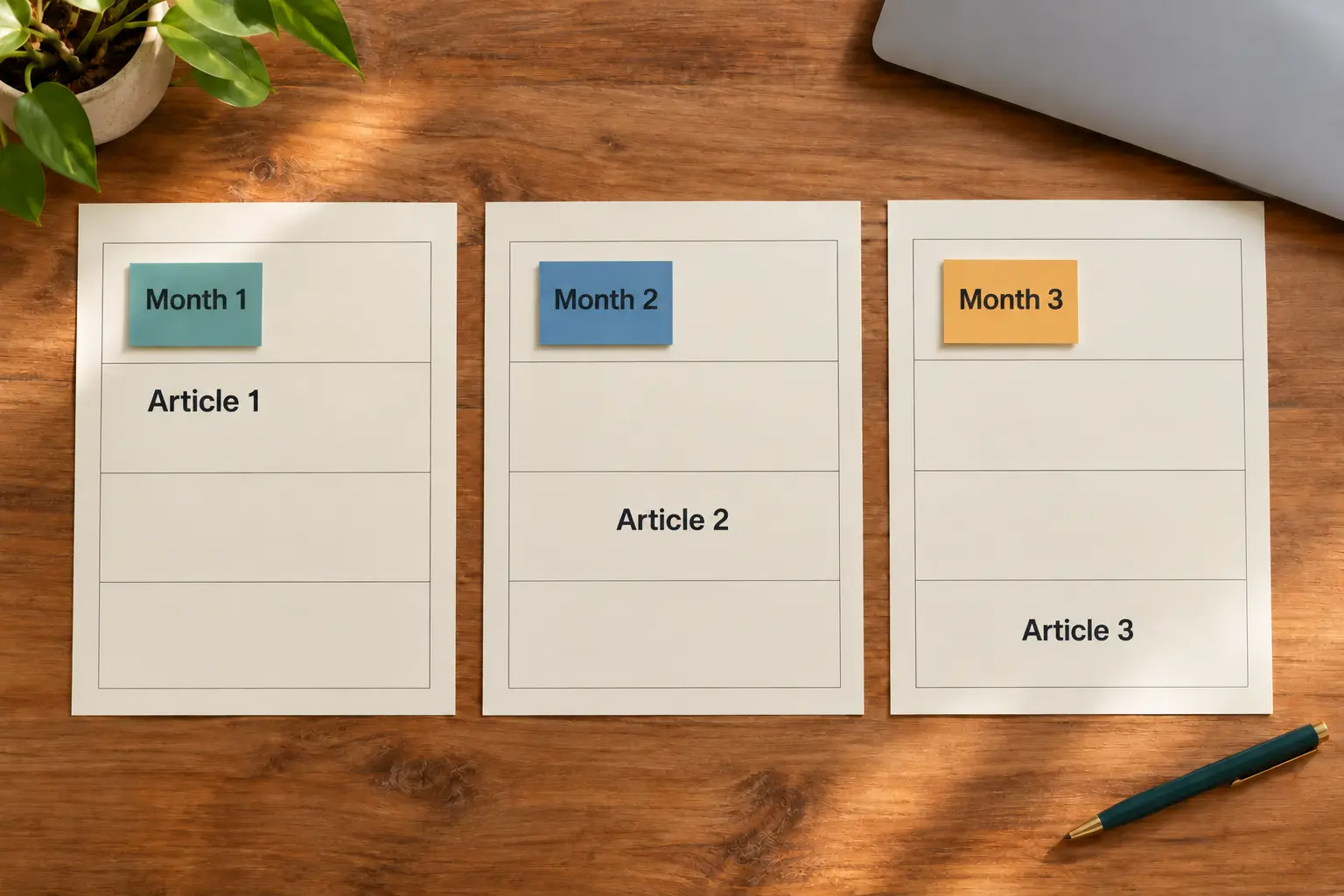
A simple sequence might look like this:
- Month one: Answer a frequently asked question.
- Month two: Compare two common options.
- Month three: Publish a checklist or preparation guide.
This gives your blog variety without creating an unrealistic workload. If you are still deciding how often to publish, our guide to a realistic small business blog schedule explains why consistency matters more than an aggressive calendar.
Keep a running idea list as new questions appear. A note after a customer call can become next month’s article. Over time, your blog begins to reflect the real concerns, decisions, and language of the people your business serves.
Useful content is more valuable than constant content
A good business blog does not need to comment on everything. It needs to become reliably helpful within the subjects your company understands.
Start with one customer question. Answer it clearly. Add an example. Give the reader a sensible next step. Then repeat the process on a schedule your business can maintain.
If your team has plenty of expertise but not enough time to turn it into finished articles, a managed blogging process can handle the planning, research, writing, formatting, and publication steps. See What Does a Blog Management Service Include? for a clear breakdown of that process, or contact Managed Authority Blog to discuss a realistic content plan for your business.